The Flight of the Sorceress

The Flight of the Sorceress
Front and Back Covers

Saturday, April 16, 2011

WHEN POPES WERE PEEPS: FUN “FACTS.”

When I began writing The Flight of the Sorceress, I was sort of forced into learning a bit about the early popes, most of whom ended up being martyred. So, one thing led to another and I fell into a rabbit-hole, rumor mill of papal anecdotes. In the spirit of Lent, Passover and Easter, I decided to do a “diversity tour d’pope.”  Now some of you may ask: “Why is he picking on popes? Why not be more ecumenical?” The simple answer is that the popes were the ones who declared papal supremacy and papal infallibility. Having assumed top billing on matters related to the Kingdom of Heaven, it seems to me that they made themselves fair game. Anyway, here are a few diversity stories, I turned up.

POPE JOAN: THE WOMAN POPE


In the town of Mainz, Germany around 800 A.D. English missionaries who were attempting to convert the pagan Germanic tribes to Christianity founded a monastery called Fulda, which became a center of education, but it was only for boys. However, a monk named Martin Polonus tells of a young woman from Mainz who learned Greek and Latin and became "proficient in a diversity of branches of knowledge." It is believed that to get this education she disguised herself as a boy.

Such a disguise may not have been as hard a task as it seems today. Back then, personal hygiene was virtually nonexistent. Nobody bathed. There were 12-year-old popes and a 5-year-old archbishop. In fact, there are credible accounts of over 30 saints' lives in which women dress as men. They are called "transvestite nuns." In one such case, St. Eugenia became a monk while disguised as a boy. She was so convincing in fact that she was brought to court on charges of fathering a local woman's child. She was forced to prove her innocence by baring her breasts in public. In the ninth century, the Vatican was home to cross-dressing saints.
Polonus wrote that this woman from Mainz was "led to Athens dressed in the clothes of a man by a certain lover of hers." Indeed, the heroine of Flight of the Sorceress, Glenys, does something similar. Joan, known as John Anglicus, or English John, became secretary to a curia, a cardinal, and then, according to Polonus, "the choice of all for pope" in the year A.D. 855.  

Pope Joan was only discovered to be a woman when she gave birth unexpectedly in the middle of a procession. Accounts vary on whether she was immediately killed or shuttled off to a convent. The Church and many historians dispute the accuracy of this story and call it a myth. But apparently there is an unaccountable 2-year gap in popes around that time. So a Pope Joan is not so far fetched.


A BUNCH OF “JEWISH” POPES

Obviously, the very first pope, Peter, was a Jew. His original name was Simon.


The next one I was able to locate was Pope Zosimas, 417-418 A.D.  Zosimas is mentioned in The Flight of the Sorceress. His father’s name was Abram, which is the big piece of evidence in support of his being Jewish.

About seven hundred years after Zosimas, Anacletus II, was elected as pope (1130) by a majority of the College of Cardinals.


Originally named Pietro Pierleone, he was the great-grandson of a Roman Jew, Baruch Pierleone. Anacletus II studied in Paris and was made a monk in Cluny, France. He was named a cardinal in Rome in 1116 by Pope Paschal II. His reign as pope was one of the most tumultuous in the history of the Church. At the time of his election, a minority of cardinals elected as pope Cardinal Gregorio Papareschi, who chose the name Innocent II. This initiated a serious schism in the church. Bernard of Clairvaux, who was a zealous supporter of Innocent in France, apparently forgetting about St. Peter himself, wrote ironically of Anacletus II: "to the shame of Christ a man of Jewish origin was come to occupy the chair of St. Peter."

There are two other popes who reigned before Anacletus who were also descendants of the Pierleone family: John Gratian Pierleone, known as Gregory VI, 1045-1045;


and Gregory VII, 1073-1084.


Gregory VII. Gregory contested the right of lay leaders, such as the Roman emperors, to grant church officials the symbols of their authority. Gregory VII was elevated to sainthood and canonized in 1606.

NOW ON TO THE GAY POPES
 

First up is Pope Paul II. Pietro Barbo was born in Venice on February 23, 1471 to a rich merchant family. His uncle was Pope Eugene IV and by 47, he too became pope. He liked to call himself Pope Formosus, from the Latin meaning, "beautiful, handsome". However, as you can see from his profile, he was anything but. It took some persuasion but he finally settled for Paul.

Paul had quite a sex life, not just for a pope, but for anybody. Paul has been accused of preserving a certain unsavory papal “tradition.” Allegedly, for several centuries, popes maintained a convent full of sex slaves who were particularly adept in staging satanic sexual orgies as well as producing babies for sacrifice.  Although this is not really supported by documentation and sounds like the kind of stuff that would be whispered in the medieval alleyway, we all know what can happen with “evidence” especially when the powerful want to get their mitts on it. But there is apparently substantial written material attesting that Paul liked to keep the company of attractive young men while shunning women. Easily moved to tears at the sight of his favorite boys, Paul’s cardinals referred to him as "Our Lady of Pity". Paul supposedly died of heart attack while being sodomized by a boy lover. 

Paul was succeeded by Pope Sixtus IV (1471-1484), another gay pope:


Educated by the Franciscans, Fransesco della Rovere was a priest and skilled theologian by the time of Pope Paul II's death. When elevated, he took the name Sixtus. Immediately after his election, he appointed two nephews, Pietro Riario and Giuliano della Rovere (who later became Pope Julius II), as cardinals. In all, Sixtus elevated six of his nephews to cardinal. Nephew Pietro was the Pope's lover, and Sixtus lavished riches on him.

And last, but certainly not least among the identifiable gay popes is Julius III (1550-1555)

Giovanni del Monte was born in Rome, September 10, 1487 and took the name Julius III. Julius was always “out,” but in his sixties he got really far out. He brazenly plucked a cute 14-year-old boy, ironically named Innocenzo, off the streets of Parma, had his brother adopt the kid, and then promptly named him a Cardinal. The Venetian ambassador reported that Innocenzo shared the pope's bedroom and bed. The relationship became a staple of anti-papal polemics for over a century

AFRICAN POPES: SOME DARKER THAN OTHERS

According to Church historians, there have been three “black” popes. Though they are described as “black,” the pictures more accurately would portray them as “dark.” They definitely were Africans, but the old chronicles use of the term “black” really tells us more about what the ancients though of as white, than anything else.

Pope Victor I (186-198 A.D.)
Until Victor's time, Rome celebrated the Mass in Greek. Pope Victor changed the language to Latin. Other than that, he got himself martyred.

Pope Miltiades (311-14 A.D.)

This pope was probably a Berber. It was during his short tenure as pope that Emperor Constantine presented him with the Lateran Palace, which became the papal residence and seat of Church government. Also during Miltiades’ reign, Constantine granted Christians freedom of religion and restored church property.

And finally:
Pope Gelasius (492-496 A.D.)

Gelasius did much to provoke the split in the Church between East and West, asserting the primacy of Rome, which needless to say, pissed off the more powerful Eastern Emperor and the Archbishop of Constantinople. Not satisfied with stirring up international shit he also created a ruckus in Rome suppressing ancient pagan festivals and declaring the Manichaean sect to be heretical because they refused to take communion in the form of wine, knowing the sect believed using alcohol to be sinful. But once he got rid of the Manicheans, the old method of communion—just bread—became okay again. Such high-jinx earned him sainthood. But, more telling is that there have no dark-skinned, black or African popes since him.

Thursday, April 14, 2011

Cherie Reich: A Resource Worth Checking Out.

Check Out: Cherie ReichWriter, Freelance Editor, and Library Assistant
http://cheriereich.webs.com
http://cheriereich.blogspot.com
http://surroundedbybooksreviews.blogspot.com

She reviews, edits and writes. She's a member of the Wild Child Bunch. Her work: Once Upon a December Nightmare is Now available from Wild Child Publishing

Wednesday, April 13, 2011

GOOD CHARACTERS IN NEED OF A NOVELIST


Are you blocked at the moment? Can’t think of something worth while to write about? Well, I know, because of your names and photos that unless you are doing a pretty damn good job of hiding it, most of you are women. And a lot of you lament the absence of women as heroines, especially in historical contexts. After all, except for such rare notables as Eve, Helen of Troy, Cleopatra, Jean d’Arc, Queen Elizabeth and Abigail Adams, women pretty much got written out of history, didn’t they?

Well, I’ve got a couple of good ones that some of you ought to take a crack at if you’re up for it. Me? If got other things on my plate, but believe me when I say I’m tempted. But, Id sure like to read about them, after some enthusiastic novelist does her research.

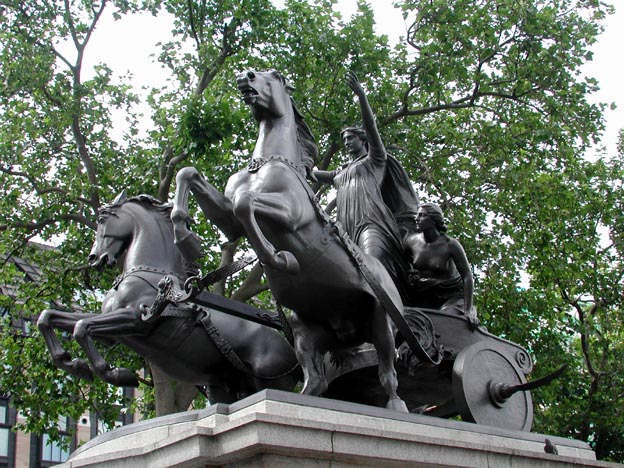
First, for those of you into the Celtic thing (and I know you’re out there) how about Queen Boadicia. Her story is briefly told in The Flight of the Sorceress.

                            Queen Boadicia: Photograph 1999 by George P. Landow.
Celts called her Victoria. Her husband was the king of the Iceni tribe. She had two teenaged daughters. Her husband trusted a Roman notary draw up his will bequeathing half his lands to the Emperor Nero while reserving the remainder for his wife and daughters. But under Roman law, unlike the laws of the Iceni, women couldn’t inherit if there was a male heir. So after the king died, the Roman prefect decided that Emperor Nero was the male heir, and therefore all the king’s lands belonged to him. Queen Boadicea and her daughters received nothing. When she protested this injustice, she was beaten in public, and her two daughters were raped. Queen Boadicea raised an army that numbered 200,000 whose ranks included many fierce Celtic women. They marched on the Roman settlements, destroying Camulodunum (modern Cambridge.) Though the Romans sent a powerful legion against her, she defeated it, and then went on to conquer Londinium (London)  and Verulamium (St Albans.) In all, her armies killed more than seventy thousand Romans before she was finally defeated in battle. She took poison to prevent her capture.

And for those with a more classical Roman bent, my other suggested heroine is Princess Placidia. 
 
                                             Princess Placidia: Museo Civico Cristiano in Brescia 
Placidia plays a small role in The Flight of the Sorceress, but deserves a lead in a story of romance and intrigue all her own. This twenty-tow year old sister of  Emperor Honorius who fled Rome in just ahead of the advancing Visigoths in 401 A.D. was left  in charge of Rome but her terrified brother took the whole army with him leaving her without any organized military to defend the city.  Nevertheless, and without any military experience whatsoever, she successfully held off a vast invading force that had already conquered all of Gaul and northern Italy. The city was only taken by the Visigoths by a ruse, and then after a spate of cannibalism within its walls. Placidia was taken captive by Alaric, the King of the Visigoths, but he died shortly after and his brother, Athaulf, took his place. For inexplicable reasons Athaulf turned his army around and returned to Gaul taking Placidia with him. Did she go as wife or prisoner? Was she somehow responsible for saving southern Italy from a Visigoth invasion?

Athaulf was murdered in 414 A.D. Placidia was then treated like a slave and ransomed back to Emperor Honorius. She was then married to a general who became co-Augustus. Meanwhile she fought with her brother, with whom she may have had an incestuous relationship. In 423, Honorius died and Placidia was made Augusta — empress in the West. She had two children, one of whom later became Emperor Valentinian III. The creative options are endless.

Friday, April 8, 2011

Book Promotion: POD As A Marketing Strategy


There is no question that e-Books represent the future of publications. On March 21, 2011, The Association of American Publishers reported that e-sales more than doubled from $32.4 million in January 2010 to $69.9 million in January 2011. Meanwhile, hard cover sales fell from $55.4 million to $49.1 million, and mass market paperbacks, a format that's declining as baby boomers seek books with larger print, fell from $56.4 million to $39 million. E-book sales were as high as 50 percent of the total for some works, not just for commercial fiction, but even for so-called "midlist" books that depend on reviews and word of mouth. And there is a lot of evidence that sales of e-Books in children’s and YA genres are skyrocketing. That also stands to reason. Youth are more tech-savvy and comfortable with the hardware. They have no especially fondness for the recollected reading experiences of the over-forty crowd. Science fiction is also doing well because of the “techie, trekkie” connection.

We know that certain genres sell in e-Book format better than others. Romance and erotica do quite a flourishing business in e-Books. In December 2010, Sourcebooks, said that its third quarter reports showed that e-book sales accounted for 27-percent of its romance inventory even though total e-book sales account for around 10-percent of total book sales nationwide. E-book sales at Random jumped 250% in 2010 and accounted for 10% of sales in the U.S. (about $140 million). Penguin also had a big jump in e-book sales, 182%, which generated 6% of Penguin's worldwide sales, or $101. Simon & Schuster's e-book sales rose 122% last year, helping to offset a decline in book sales in the adult group, and e-books represented 8% of revenue, roughly $63 million. Hachette Book Group had strong e-book sales gains in 2010, the format accounting for 10% of its sales last year. Clearly, e-Books are set to outpace all print formats soon. Even the NY Times Book Review section has begun to take account of e-Book sales. 

There are also the travel and reference books that one used to lug around on vacations. Now it is more convenient to download them onto your Kindle of iPad, along with maps, itinerary, and foreign language dictionaries. (Like me, you may also want to download a Bible, Quran, or other useful cultural adjunct for your destination. They weigh nothing and these are available for free from the Gutenberg Project.) Marketing e-Books for these potential buyers just makes good common sense.

Do these statistics tell all? Part of the attraction for an e-Book is that the purchase can be made with relative anonymity. Books that once were kept behind the counter and sold in plain brown wrappers are right out there now in the e-Book world. It is not hard to envision that promotion of romance and erotica involves different strategies than other genres. 

But what if, like me, you have a traditional historical, or a murder/mystery, a cozy or a conventional thriller? Do the same considerations apply? Can I, with a historical thriller, simply ignore a print market? Should I, even when after sending out several promotional emails I received back responses from approximately 15% of the recipients saying they would wait for the print version?  This could amount, conservatively, to 20% of total sales alone, not counting potential sales at the kind of public events I described above and subsequent recommendations. 

To determine the value of POD as part of my marketing strategy, I have undertaken some research, which may be useful to others as well as to me. My investigation and conclusions though are not a universal endorsement of POD and come with a caveat: the usefulness of a POD as a marketing tool is genre-dependent. It may be totally inappropriate for a different genre. However, to cut to the chase, as they say, I conclude that for those seeking to promote literary fiction, traditional mysteries, who-done-its and straight historical novels, you may want to consider the POD instead of putting your money into a website ad.

I have come to the conclusion that investing in a POD version of The Flight of the Sorceress is probably the best promotional investment I can make. I am going to do it. It is not a question of vanity. The Flight of the Sorceress has a five star rating now on Amazon and plenty of good reviews. Since you are already reading this on the blog, you can easily see that the book is quality. The feedback from published authors has been great.

The Flight of the Sorceress was published in Oct. 2010s only as an e-Book. Previously, I published in print a semi-autobiographic novel, Bring The War Home! that sold approximately 1000 print copies and has somewhere over 2500 downloads in e-Book format, although most of those are give-aways. I currently have a list of folks who want a print version of The Flight of the Sorceress. I want to provide these people with a print version of The Flight of the Sorceress. But doing so requires an investment.

I began my inquiry by asking members of my writers’ groups what they thought. One told me he sells three e-Books for each print copy, but that he considered the POD version a mark of the credibility of his work. Another pointed out that the print version is essential for public appearances. This, he noted, did not include bookstores, where, after you deduct production costs and the bookstore cut and the publisher’s cut, leaves the author a meager royalty. On the other hand, there is profit to be made if the venue for readings is a solon, reading group, book party or something similar. I sold hundreds Bring the War Home! at such events, because I had a stack of books and a pen to autograph them. Both of these very fine writers agreed that the ability to deliver the product in multiple forms has an incremental value that ultimately enhances e-Book sales.
In July 2009, Bowker reported:
  • 57% of book buyers were women and purchased 65% of the books sold in the U.S.
  • Mystery books were the most popular genre for book club sales, with 17% of all purchases of mystery books coming directly from book clubs
  • Generation X consumers buy more books online than any other demographic group, with 30% of them buying their books through the Internet
  • 21% of book buyers said they became aware of a book through some sort of online promotion or ad
  • Women made the majority of the purchases in the paperback, hardcover and audio-book segments, but men accounted for 55% of e-book purchases
Admittedly, these statistics are stale. (I tried unsuccessfully to find on-line statistics on e-Book sales by genre. There are no charts or graphs to compare.) But, with respect to The Flight of the Sorceress, they remain relevant. The Flight of the Sorceress is a historical thriller and its two protagonists are heroic women, valiantly resisting the combined forces of church and state who are striving to even further subjugate women and to snuff out classical knowledge. 

I like to think I know my potential reader market. Older women are more likely to buy this book and are more likely to want to read it in print. They still like to browse in bookstores. They grew up reading books under the covers, using a flashlight to fool mom and dad. They tend to relish their Luddite-side. Though they are older, they are not dead and they tend to have disposable income when it comes to books. They are more likely to be members of book clubs and to participate in book groups. They talk to their friends about books and recommend books. The older they get, the more sedentary they become and the more books they read. So despite the trends overall in e-Book sales, there is a clear, residual market for print in my genre.

Earlier, I mentioned that one of the attractions of e-Books, especially with romance and erotica is the anonymity associated with the purchase and the reading experience. You can sit on a subway with your Kindle and read without anyone snickering at a cover displaying oiled-up six-packs and air-brushed silky breasts. My potential readership though may be quite different. They would not be at all embarrassed to read The Flight of the Sorceress on the subway.  I think of my cover as a mini-billboard. I want it to be seen, lying openly on an office desk for a week or so. I want my readers to carry it with them as they commute. I want them to show it to their book groups. Getting one of them to read my book would be the tip of a marketing iceberg. I want book buzz and there’s a lot to be said about the demographic that still reads print and talks about what they read. 

Another consideration one needs factor into a decision whether to go to print is reviews. Many reviewers will not accept an ARC in e-Book format. The Historical Novel Society, a natural review and promotional site for The Flight of the Sorceress is not e-Book friendly. And even though my novel delves deeply into the destruction of the great library at Alexandria, the ALA was not interested in reviewing it. Step-by-Step posts a list of reviewers. Many of them will not accept e-Books. See: http://www.stepbystepselfpublishing.net/book-reviewer-list.html. Most newspapers will not review e-Books. Indeed, I have been unable to get The Flight of the Sorceress reviewed by Litseen in San Francisco, even though they eagerly reviewed my ten-year old novel Bring the War Home!  

Up to now, I have refrained from discussing bookstores. You know where things are headed with a business model when you see signs saying “Support Your Local _______” Fill in the blank. It could be drug store, appliance repair or blacksmith. Currently, it is bookstores. I have a wonderful local bookstore just down the street called Bird and Beckett. It is author-friendly when it comes to readings. It prominently displays local authors. It has jazz nights and poetry reading nights. It trades second-hand books. It is a wonderful, valued community resource and I am on a first-name basis with Eric, the proprietor. He will welcome a reading from me with a POD. He doesn’t want an e-Book reading. I respect that business decision. I also know that I wouldn’t make much money from a reading at Bird and Beckett. I would do worse at more distant and unfamiliar bookstores, the further I strayed from home, to the point where I’d end up driving a couple hours and spending $15 on gasoline for four hours away from family or other activities. Authors who go to bookstore events are very lucky to sell a couple dozen books. If that happens, they’ll make $25 and maybe net $10 while copping a headache from the cheap wine. I have been to some of these events to support friends who are fine, published authors. I have shared their disappointment as they stoically press forward, reading to five or six listeners, three of whom have already read draft versions of the work in their writers’ group. I have done bookstore appearances where I’ve sold as few as a single copy. 

Bookstores show very little upside for an author. We may lament this, but the bookstore, I am afraid, is a losing proposition for most authors. It is really a consignment business. They want to be able to return unsold books. They need at least 50% of retail to cover their overhead. Unless you have amazing clout, all that’s going to happen is that they will take one or two of your books and put them on a shelf, spine out, where they will languish before being returned. 

In my experience, the most profitable time an author can spend is at book parties, thrown by friends and acquaintances, or in cultivating book groups who will by your book and then recommend it to other readers as well as events such as San Francisco’s Litquake. Authors can also make the most money there because they can often purchase their POD books at an author’s discount from their publisher. At such events, each sale of a publisher-published book can earn the author as much as $6.00/book for a $15 retail product. Moreover, attendees are both readers and recommenders. There is potential for post-event buzz.

POD from the point of view of a marketing strategy that supports an e-Book marketing plan makes good sense. If you have a publisher your typical POD royalty should be no less than 15% of wholesale price or 7.5% of retail price, as determined by them. A book from that retails at $15 will wholesale for about $7.50. In either case the author should net about $1.125 per book. Publishers take care of the fulfillment. 

On the other hand, if you don’t have a publisher or if, for whatever reason, your publisher does not want to put your book into print, you still have an option, and it’s not a bad one —self-publishing. Lightning Source can print a good quality POD book with a full color cover for about $4.80. Amazon and B&N will want 55% of cover price to sell it. If the retail book price is $15, the author will get around $3.45 per book sale provided the author does the fulfillment and charges for delivery and packaging.This cost is about $3.00 per book, tacked on to the price.With a self-published POD book, an author can make $10.00+ per book at events and $3.45 through outlets like Amazon. Through a publisher, the author would receive a royalty of $1.125 on direct sales and slightly less on an Amazon or B&N sale. 

But even that is not the whole story. Having a reputable publisher adds value, including credibility, to the product. While POD can get an author in the door with more reviewers, having a reputable publisher opens the door even wider, and it creates consumer confidence that is essential to marketing. This combo of POD + publisher credibility stands a good chance of picking up the 20% readership that would not ever see the book, recommend it or ever talk about it. And that 20% may actually make the tipping point that we all want so desperately to reach. 

So if you are planning on investing in your marketing, you can choose conventional on-line ads. There are so many different blogs, websites and social networking sites that there is no point in making a cost/benefit analysis. Especially since demographics and genre have to be factored in. However, depending on your market, don’t overlook the POD market as a promotional opportunity. 

I view POD as a promotional expense, as valid as any other form of publicity. I think that for my book, The Flight of the Sorceress, I can generate more e-Book sales if I have a POD product available for public events. And I think that a physical book sells books because it is seen. Beyond that, with a print version, I even stand a chance of making money back in the process, rather than just seeing the cash flow out to websites and PR advisors who promise promotional exposure. 

For The Flight of the Sorceress I think it’s a better deal than an ad, and in any event, I wouldn’t spend money on an ad in an e-venue, unless I can sell in both formats. Why spend money on any promo that doesn’t sell your product in all its potential iterations? So, I look forward to producing the print version of The Flight of the Sorceress in the very near future.  


Saturday, April 2, 2011

Ancient Robots? No Way!


Ancient Robots?  No Way! 

Did you ever imagine that Alexandria had coin-operated vending machines and viable plans for robotic kitchen help, nearly two thousand years ago?

In my historical novel, The Flight of the Sorceress, you will find a brief reference to an inventor named Hero of Alexandria, who lived contemporaneously with Jesus Christ. Hero constructed the first known steam engine and also a rudimentary rocket engine. He invented the first coin-operated vending machines. In about 60 AD, Hero built the first programmable robot, a cart that could carry a group of automata to the front of a stage where they would perform for an audience. He developed plans for a robot that could automatically pour wine.

But even Hero stood on the shoulders of inventors who came centuries before. Some historians point to the Greek, Archytas (428–347 BC) as the earliest of these. Called the founder of mathematical mechanics, Archytas, whose own writings do not survive, was reputed to have designed and built the first artificial, self-propelled flying device propelled by a jet of what was probably steam. It was said to have actually flown some 200 meters.

Two centuries later, Ctesibius, who lived between 285-222 BC, wrote treatises on how air could be compressed and used for pumps and even to fire cannon. He invented a clock that kept better time than any clock created thereafter until the pendulum clocks that were developed in the 17th century. He is called the father on pneumatics.

Although he was affiliated with the Library of Alexandria, the works of Ctesibius do not survive. Nor do most of the works of Hero. We have only a portion and those were saved by the Muslim conquerors of Alexandria.

The Flight of the Sorceress tells the story of the consequences of religious intolerance and the destruction of inconvenient knowledge by religious extremists of all stripes. It can easily be postulated that because the Church-sponsored Dark Ages, humanity is at least a thousand years behind in its state of knowledge. Religious zealotry destroyed so much classical learning, burnt so many books and wiped out the work of so many brilliant minds, all in the name of God, that our scientific and cultural losses cannot even be estimated.

Today, I read the paper to find that two very stupid ministers, Wayne Jones and Terry Sapp, ministers of the (absurdly misnamed) Dove World Outreach Center in Florida burned a Quran in Florida in front of their flock of very stupid parishioners. And upon hearing about this book-burning, three very stupid mullahs incited hundreds of very stupid followers to go on a rampage and kill Americans. When the mob couldn’t find any Americans upon whom to vent their rage, they settled for four Nepalese, a Romanian, a Norwegian and a Swede. Another ten people were just murdered in Kandahar (races, genders and religions to be announced.)

It’s not like this stupidity came out of the blue. Last September, Gen. David Petraeus warned Wayne Jones that burning the Quran would set off this kind of rioting. Yet he and Sapp went ahead with their book burning, with the apparently enthusiastic support of their cretin following. They all knew that their actions would incite people to riots that could lead to deaths. And the equally narrow-minded mullahs in their mosques in Afghanistan knew that haranguing the idiots who listen to them with hate-filled sermons would summon up a murderous rage.

Not all followers of Islam or Christianity are like these people. Actually the inciters and the rioters have more in common with each other than with their supposed co-religionists. They think alike in their intolerance. They act alike in their appeal to hatred and violence. And they have the gall to place all the responsibility for the consequences of their personal behavior on God. All of them are co-conspirators in an incitement to mob violence. They are felonious miscreants and accomplices in murder.
 
The Flight of the Sorceress, though a novel, seeks to impart a timely warning. We will reap much more of this if we allow ourselves to stumble into the quicksand of religious intolerance. If we continue to sow the seed that the U.S. is a Christian nation and not a secular state, we will only accelerate that process. We will become a nation of book-burners, ever in need of the sword, always living in fear, behind walls and parapets, mistrustful of each other, ready to cast blame everywhere but upon ourselves. And when the bonfire of words dwindles to embers we won’t flinch tossing on people to keep the flames a-burning. That’s what happened during the Dark Ages, and there’s no reason to think that civilization has completely recuperated from that first go-round. After all, from a scientific standpoint, we’ve not come a lot further than first century Alexandria with its coin-operating vending machines and rocket engines.